
Our family has a “spot” on the beach near our home. Sara walked over yesterday morning for a little beach time and quickly sent me a text that someone was sunbathing in our spot:
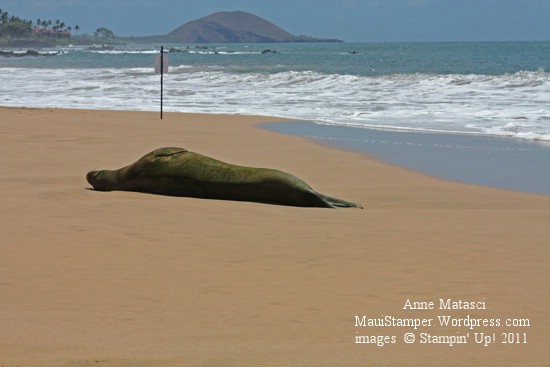
This is the Hawaiian Monk Seal, specifically an 11 year old female. Since she is a member of an endangered species, there were signs posted around her to remind her adoring public that she needs her space and should not be disturbed. I didn’t think taking a couple of pictures would disturb her, but the surf didn’t cooperate with her snooze:

We’ve had a pretty good swell going on the south shore for the past couple of days, and apparently she didn’t calculate enough distance for herself. She got a good soaking, rolled about 3 times (not easy for a girl her size!) and moved up the beach a little:

It’s a bit of a pity that I didn’t have a video camera on me. Although she is graceful in the water, her locomotion on the sand is what I would call galumphing.
Once she moved past the (present) high tide mark, she settled comfortably on the sand but kept an eye on me:

Volunteers from the community were on the beach providing information about the Hawaiian Monk Seal (and making sure the two-leggers kept their distance.) They assured me that this seal was healthy and had likely selected this spot (Our spot!) for a little R&R while she went through molting. All that lovely green algae growing in her fur will be shed in the next few weeks as she drops that coat and a new one comes in.
I’ll keep you posted.

 The Maui Stamper